The pool typically is open during the summer months, and maintaining the pool involves
- Daily testing of chemical chlorine and pH levels and making appropriate adjustments
- Weekly shocking of the pool
- Keeping pool log up to date
- Sweeping / vacuuming as necessary (typically three times a week)
- Adding water as necessary
- Back flushing, cleaning and maintaining filters and skimmers
- Maintaining furnace functionality / water temperature levels
- Assuring that all signs are properly posted and legible
- Enforcing rules pertaining to pool use
Chemicals
At the current writing (May 30, 2011) these are the crucial chemical components for maintaining the pool: Test kit, acid, chlorine tablets (tabs), and shock. Chemicals should be handled only by adults.
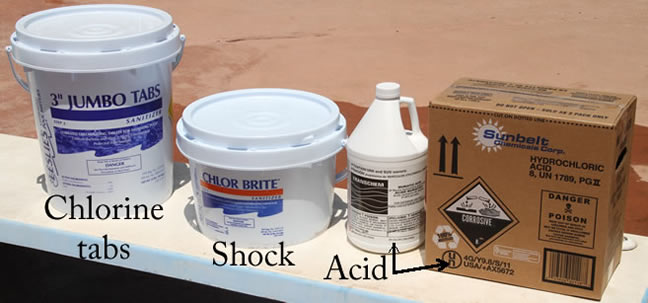
Shocking and testing
The pool needs to be shocked weekly (on Monday night). To shock the pool you broadcast four cups of shock on the surface of the big pool and one cup on the surface of the baby pool. Each pool (the main pool and the baby pool) has its own automatic chlorinator. Normally, once the chlorine has been properly adjusted at the beginning of the season, all that you need to do is make sure the chlorinators have tabs in them. The acid is only deployed on an as-needed basis, and must be done with great care. So, other than shocking the pool, how do you know when to make adjustments?
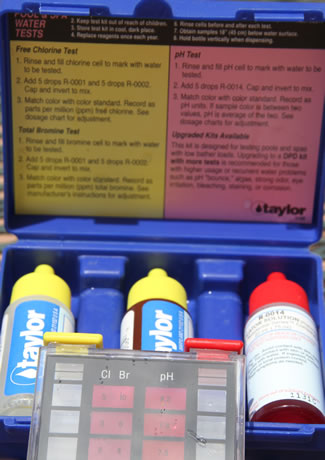
To maintain the pool in its best condition, you must test the water every day, especially during periods of heavy use. Standard procedure is to take off the yellow and the red caps from the tester and set them aside temporarily. Submerge the tester in the pool water and dump the water out a few times until you are confident the water in the testing kit is representative of the current water in the pool. With both the left (chlorine) and right (pH) tubed full to the top, a quick flick of the wrist should be adequate to lower the level of the water so its meniscus matches the fill line near the top of each tube.
According to instructions, you should drop five drops each of the two yellow-capped bottles into the left (chlorine) tube. Then place 5 drops of the red-capped pH test solution into the right (pH) tube. Now cap both tubes (yellow cap on the left, red cap on the right) and shake a few times. Hold the test device up against a plain, colorless background and read the pH on the right and the chlorine level on the left. Chlorine should be between 2 and 5; pH should read between 7.4 and 7.8. By default, Lubbock tap water will have a chlorine reading less than 1 and a pH level above 8.
If the pH reading you get is 7.8 or above, you need to add more acid. NOTE: this must be done gradually and gently, so as to not splash acid on yourself. Do not inhale the fumes. Add an entire gallon of acid. THERE SHOULD BE NO ONE IN THE POOL. The best time to do this is after the pool closes at 10 p.m. and before 7:30 a.m. (the pool opens at 10 a.m.). It is unlikely you will get a pH reading below 7.2 except in the hours immediately following the addition of acid. Immediately dispose of the plastic bottle and wash your hands thoroughly after handling the pool acid. The acid we use is hydrochloric acid (HCl) so strong and concentrated it has a special name – muriatic acid. To all intents and purposes it is pure acid and is not to be trifled with. Always HANDLE ACID WITH CARE.
If the chlorine level is low, you need to be sure there are tablets in the chlorinators. If there are tablets, check with one of the persons trained and more experienced on the pool equipment before making any adjustments. In fact it is a good idea to have one such person “on your shoulder” for any of these steps until you get used to the process. NOTE: Chlorine levels are most subject to variation based on the amount of use the pool gets, the prevailing temperature, sunlight, wind, and other environmental factors. Adding acid as described above, often messes up the chlorine readings for a day or two.
Pool log
Any time you test water, you should make an entry in the pool log. We ordinarily do not want to test the water more than once a day, in part because the test kit chemicals are somewhat costly. So if you are designated to monitor water, or you just feel an urge to test the water, check the log first. If water has been tested that day, please do not duplicate the earlier effort. If you test the water, record your results. If you take action (add acid, add tabs), record that as well.
Sweeping and vacuuming
Any number of things will introduce dirt into the pool. First, there is the good ol’ West Texas wind and dust – you know, the stuff that settles on your window sill. And then just having human bodies use the pool will introduce a fair amount of dirt on its own. Just as a house needs to be swept and vacuumed, so does a pool. Fortunately, we have a robot pool sweeper that runs overnight as good members on the pool maintenance committee take charge of running “Robby.” A separate manual for running “Robby” can be downloaded here.